About
The Idea
War Graves Day began as a school project for the 72nd European Youth Competition — an exercise in asking a simple question: what happens to remembrance when the people who remember are gone?
The answer was uncomfortable. The war cemeteries of Europe are magnificent, moving places. They are also quietly fragile. The organizations that maintain them — the Commonwealth War Graves Commission, the German War Graves Commission (Volksbund Deutsche Kriegsgräberfürsorge), the American Battle Monuments Commission, and others — depend on public attention, political will, and in many cases, donations. All three are easier to sustain when people actually visit.
Visitor numbers are slowly declining. A generation is aging out. And without a deliberate effort to bring the next generation into contact with these places, the cemeteries risk becoming invisible — well-kept, but unvisited. Honored in name only.
War Graves Day is an attempt to change that, one school trip at a time.
What We Stand For
We believe that war cemeteries are among the most important places in Europe — not because war was glorious, but because it wasn’t.
These are places of enormous loss. German soldiers. British soldiers. French, Belgian, Dutch, American, Commonwealth soldiers from dozens of nations. Enemies buried near each other on the same ground, tended by the same hands. The cemeteries do not take sides. They count.
Our approach is built on three principles:
No Heroism
We do not glorify war or celebrate military power. We acknowledge suffering — on all sides.
No Competition
War Graves Day is not a rival to existing organizations or national remembrance traditions. It is a connecting point — a gateway that leads students toward the CWGC, the Volksbund, and the rich remembrance cultures of their neighbors.
No Forgetting
Current and future generations carry a responsibility. The peace that exists between European nations today was not inevitable. It was chosen, and built, and it requires active maintenance — starting with the knowledge of what its absence cost.
The Visual Language
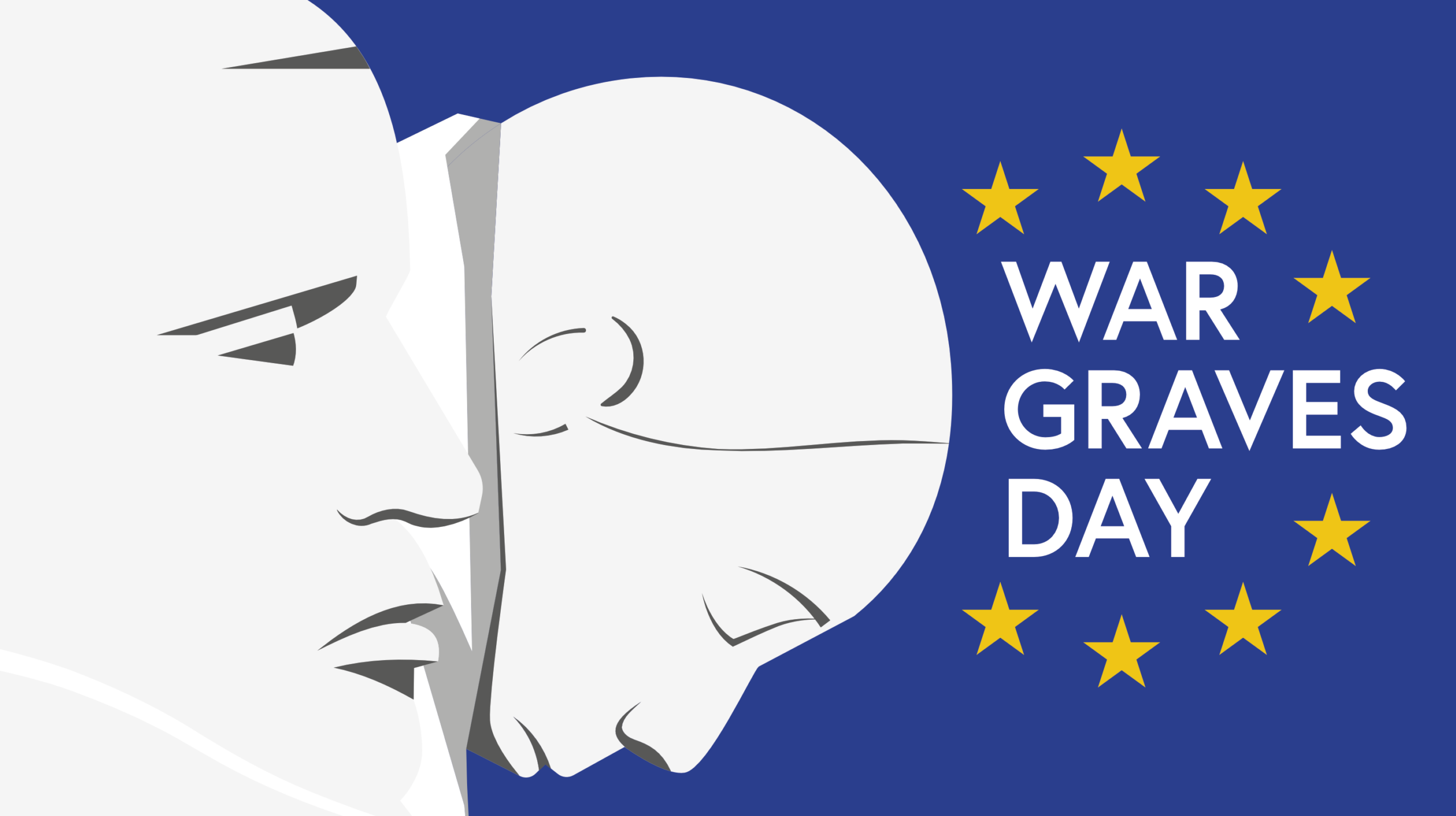
The logo at the heart of War Graves Day is not an abstract design. It references Die trauernden Eltern — “The Grieving Parents” — a sculpture by Käthe Kollwitz installed at the German war cemetery of Vladslo in Belgium.
Kollwitz created the work after her son Peter was killed on the Western Front in October 1914. The two kneeling figures — a mother and a father — face the graves of young soldiers. The father’s posture carries guilt as much as grief. It is one of the most quietly devastating monuments in Europe, and almost nobody outside the world of art history or remembrance knows it exists.
The pattern you see on our posters is not poppies. Each shape is a helmet — a soldier’s helmet, abstracted into a simple form. The number of helmets on each poster corresponds exactly to the number of soldiers buried at the featured cemetery. On the Ypres Ramparts Cemetery poster: 198. On the Grebbeberg military cemetery: 861. On the Soultzmatt cemetery: 678.
We chose helmets because poppies belong specifically to British and Commonwealth remembrance culture — a tradition we respect, but which does not speak for the German, French, Dutch, Belgian, or Romanian soldiers also buried across Europe. Helmets are universal. Every army wore them.
The Origin
War Graves Day was created by Martin Pitsch, a graphic designer and photographer based in the Netherlands, initially as a submission to the 72nd European Schools Competition. The competition ended. The project didn’t.
The initiative is currently in its early stages — a small team, a growing network, and a clear date on the calendar: May 10.
If you are a teacher, a school, a cemetery organization, or simply someone who believes this matters, we would like to hear from you.